In the remote deserts of northern Arizona lies a remarkable and otherworldly feature—a colossal scar on the Earth’s surface, a testament to the immense forces at work in our planet’s history. Meteor Crater, also known as Barringer Crater, is the result of an ancient collision between Earth and an extraterrestrial visitor. This awe-inspiring site, created over 50,000 years ago, offers a unique glimpse into Earth’s geological and cosmic past. Join us as we embark on a journey to explore Meteor Crater, a geological wonder and a portal to a time long before human history.
The Birth of a Crater
Meteor Crater, located approximately 35 miles east of Flagstaff, is the best-preserved impact crater on Earth. Its formation is an extraordinary tale that stretches back some 50,000 years to the Pleistocene epoch. During this time, a colossal cosmic event unfolded in the skies above what is now northern Arizona.
The culprit was a meteorite, an asteroid fragment traveling through space. Weighing several hundred thousand tons and traveling at a speed of approximately 26,000 miles per hour, this extraterrestrial visitor, composed primarily of nickel and iron, collided with Earth. The impact was cataclysmic.
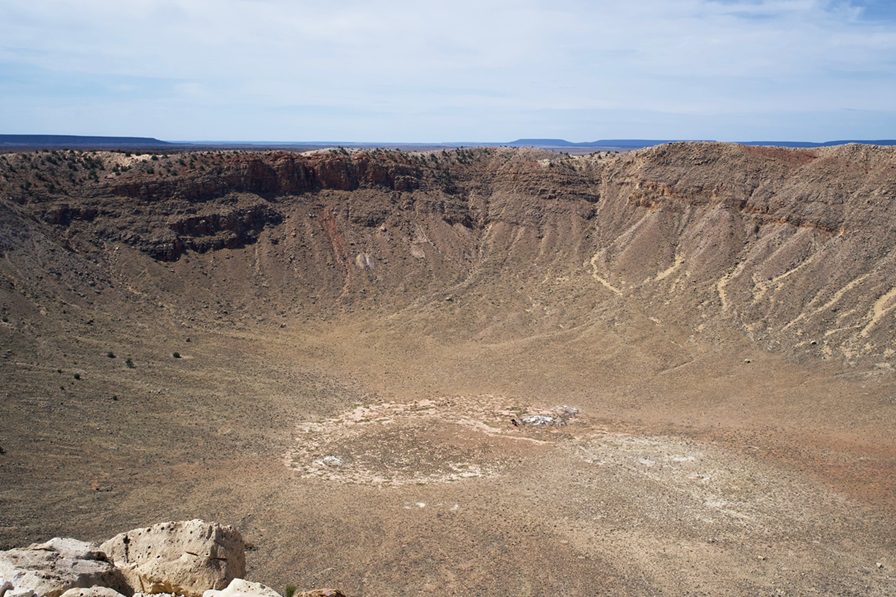
Upon collision, the meteorite was traveling so fast that the heat generated by its passage through Earth’s atmosphere exceeded 3,000 degrees Fahrenheit. The energy released upon impact was equivalent to the explosion of over 20 million tons of TNT. The result was the formation of a massive crater, over 550 feet deep and more than 2.4 miles in circumference.
The Discovery of Meteor Crater
The existence of Meteor Crater was not always understood, as its formation was a mystery for centuries. Native American tribes were aware of the site and considered it a place of great significance. However, it wasn’t until the late 19th century that European settlers came to appreciate its geological significance.
The first known record of the crater’s discovery by European-Americans is credited to the adventurous journey of U.S. Army surveyors in the 1850s. But it wasn’t until the 20th century that a comprehensive scientific investigation took place.
In 1903, mining engineer and geologist Daniel Barringer was the first to propose that Meteor Crater was indeed the result of a meteorite impact. His theory was initially met with skepticism, but Barringer’s perseverance and dedication eventually convinced the scientific community that the site was, in fact, a meteorite impact crater.
Today, the crater is named in his honor as Barringer Crater, though it is commonly referred to as Meteor Crater. Barringer’s efforts provided invaluable insights into the understanding of impact cratering, furthering scientific knowledge about Earth’s geological history and the potential hazards of cosmic collisions.
Geology and Features of Meteor Crater
Meteor Crater is a geological wonder, and its unique features offer an intriguing glimpse into the Earth’s formation and history. Here are some of its most notable aspects:
The Crater Rim
The rim of Meteor Crater stands nearly 150 feet above the surrounding desert floor, providing a commanding view of the crater’s interior. The rocky rim is an abrupt and jagged circle, reminiscent of the intense forces that created it. Visitors can explore the rim by following a well-maintained trail and take in panoramic views of the crater’s interior.
The Crater Floor
The crater’s interior is a striking landscape, marked by a flat, sandy floor scattered with large boulders. It provides a surreal contrast to the surrounding high desert terrain. The floor’s features include the remnants of an early mining operation, which sought to extract meteorite fragments from the crater.
The Ejecta Blanket
One of the most fascinating geological features of Meteor Crater is its ejecta blanket. Upon impact, the asteroid’s tremendous force expelled material outward from the crater. This ejected material, which was forcefully hurled from the impact site, is now scattered across the surrounding landscape, creating a vast, undulating expanse of debris. The ejecta blanket provides vital clues about the force and energy of the collision.
The Meteorites
The meteorite responsible for creating Meteor Crater disintegrated upon impact, leaving behind countless fragments. Over time, some of these fragments were recovered, and they are now scattered around the world, displayed in museums and collections. The largest fragment, known as the Holsinger Meteorite, weighing over 1,400 pounds, is on display at the crater’s visitor center. It serves as a tangible connection to the cataclysmic event that formed the crater.
Ongoing Research and Exploration
Meteor Crater is not just a relic of the past; it’s also a site of ongoing scientific research and exploration. The impact crater continues to yield valuable insights into the dynamics of impact events, the formation of craters, and the geological processes involved in such events.
Researchers visit Meteor Crater to study the site’s unique geology and the features of impact craters. They also conduct experiments related to the impacts of cosmic events on the Earth’s surface, an important area of study as we continue to learn more about the potential risks of asteroid and comet impacts.
The Visitor Experience
Meteor Crater is a popular destination for tourists, scientists, and curious individuals eager to explore this unique geological wonder. The site offers a range of experiences for visitors:
Visitor Center
The Meteor Crater Visitor Center provides a wealth of information about the crater’s formation, the science behind impact events, and the ongoing research taking place at the site. The visitor center features informative exhibits, interactive displays, and a gift shop where visitors can learn more about the history and significance of Meteor Crater.
Guided Tours
Guided tours of the crater are available for those who want an in-depth exploration of the site. Knowledgeable guides provide insights into the crater’s geology, history, and the ongoing scientific research conducted at the site.
Self-Guided Exploration
For those who prefer to explore at their own pace, self-guided tours are available. Visitors can walk the rim of the crater and observe the features and landscape at their leisure. The crater’s rim offers spectacular views, and visitors can appreciate the sheer scale of this natural wonder.
Meteor Crater is a testament to the incredible forces that have shaped our planet’s history. It is a vivid reminder of the profound influence that cosmic events can have on Earth’s geology and evolution. As a site of ongoing research and exploration, it continues to yield valuable insights into impact events and the potential risks posed by asteroids and comets.
Visiting Meteor Crater allows individuals to connect with the Earth’s deep history and the larger cosmos. It’s a site that inspires wonder, curiosity, and a deeper appreciation for the intricate processes that have shaped our planet for millions of years. Witnessing the impact of an ancient collision at Meteor Crater is a profound and humbling experience, one that reminds us of the incredible stories hidden within Earth’s geological features.